How to Solve Chiidoku
Turn three uniqueness rules into a repeatable clear, including late campaign colors.
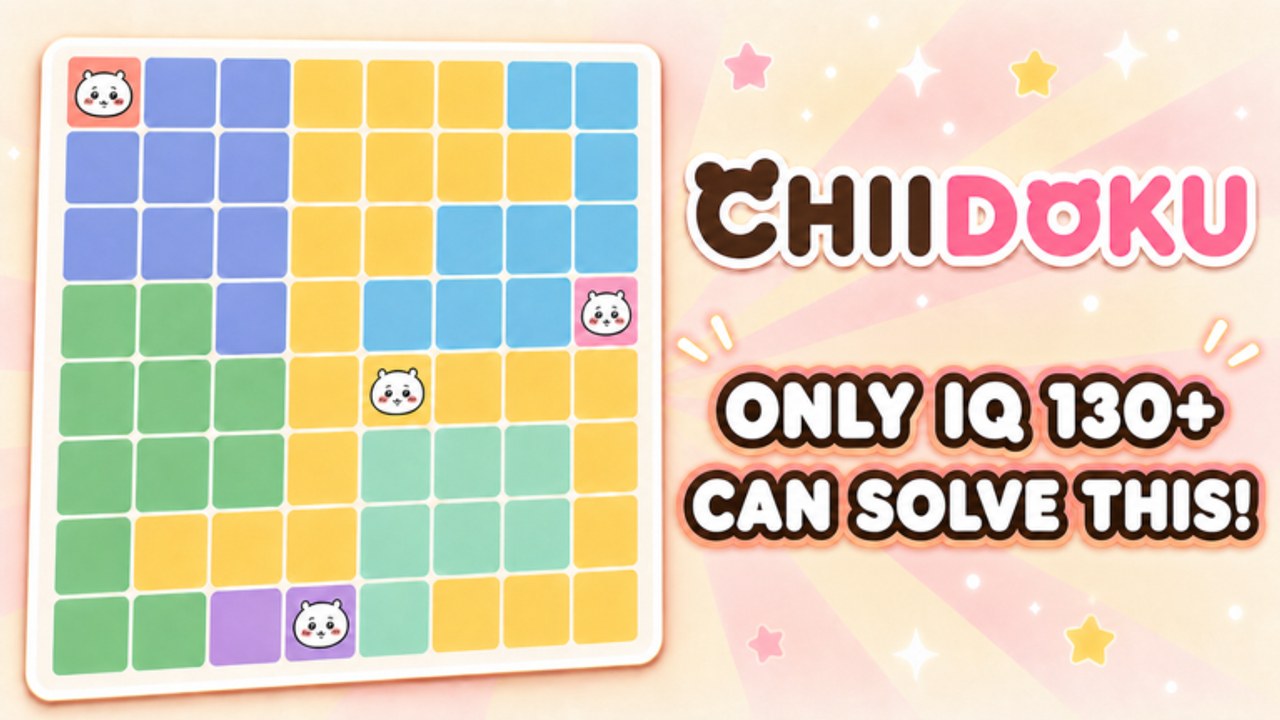
Solve in this order, every board
Chiidoku is not a hidden-object hunt. It is a uniqueness puzzle. If you place a token because the cell “looked cute,” you will meet the heart counter. Use a fixed scan instead. The same scan works on tutorial boards, the 400-level campaign, and infinite mode.
Scan A — occupied units. Mark every row, column, and color region that already has its Chiikawa. Those units are closed. Never test a cell inside a closed unit.
Scan B — forced cells (hidden singles). Look at each remaining color region. Count empty cells that still sit in an open row and an open column. If the count is one, that cell is the token. Place it. Do not admire it. Go back to Scan A.
Scan C — pointing. If every living candidate in a region lives in the same row, that row will take the region’s token. Other regions must stop using that row. The same trick works with columns. This is the Sudoku “pointing pair” idea wearing Chiikawa’s face.
Scan D — naked pairs. Two regions that share exactly the same two candidate cells cannot both be guessed. Leave both cells open until a third constraint kills one. Guessing here is how mid-campaign hearts vanish.
Only after A–D fail should you take a trial placement: pick the cell that appears in the fewest candidate lists, imagine it filled, and watch for a region that hits zero legal cells. If the trial dies, the other cell was the truth. That is still logic. It is not a coin flip.
Keep the strategy checklist open on a second screen until the order is muscle memory.
Why adjacency matters
Players arriving from Queens, Star Battle, or “one crown per color, no neighbors” will try to separate tokens. Official Chiidoku rules say tokens cannot be placed next to each other. If two Chiikawas share an edge, one of them is illegal and will cost a heart. Do not try to “correct” a pair that the game already flagged.
Adjacency is not a soft suggestion. It is a hard rule. A neighbor in your row occupies that row you wanted. A neighbor in your column occupies that column. Count uniqueness and check adjacency after every placement.
Worked pattern: the last purple cell
Imagine an 8x8-style board like the official thumbnail. A purple region of four cells sits in the lower left. Row 8 already has a token. Column 1 already has a token. Two purple cells die immediately. One remaining purple cell sits in an open row and open column. That cell is forced. Place it before you touch the pretty yellow block in the center. Pretty is not a constraint. Purple’s leftover cell is.
Then rescan. The row you just filled is closed. A green region that wanted that row now has one fewer candidate. That is how a single forced token snowballs through the grid.
Campaign difficulty is mostly region shape
Early levels use compact blobs. Forced cells announce themselves. Later campaign boards use snakes, donuts, and regions that share long borders. The rules do not change. Your scan has to get stricter:
- Start with the smallest remaining region, not the largest.
- After every placement, close the row and column out loud if you are learning.
- When two large regions fight over the same three cells, look for a column that already has its token. The fight is already over.
If you stall for more than a minute, walk away and reread getting started so you are not accidentally violating the adjacency rule.
Hearts are a timer for sloppy thought
A heart is not a hint. It is a fee. The Heart + 1 pass buys one extra fee. It does not mark the correct cell. Spend Robux after you can clear a board with Scan A–C only. If you cannot, the pass trains a bad habit.
On mobile, mis-taps look like logic errors. Calibrate with controls before you blame the grid.
Infinite mode uses the same brain
Generated boards in infinite mode raise density and meanness. They do not invent a fourth uniqueness rule. If your infinite streak dies, it is usually because you skipped Scan B and jumped to a trial. Slow down for one extra scan. Streaks grow from boredom-proof process, not from speed clicks.
What not to import from other puzzles
- Minesweeper chording. There are no hidden numbers you must reveal.
- Sudoku digit pencil marks for 1–9. You are placing one token type, not nine digits.
- Queens adjacency rules. They are reversed here. Adjacency is forbidden, not allowed.
- Auto-solvers. Read scripts if you insist, but an auto-place tool will not make 400 levels feel better.
Practice loop that actually sticks
Clear three campaign boards with a paper note of which scan found each token. Then run daily missions for coins. Then take one infinite streak. That loop also feeds character unlocks without turning the shop into the main game.
When you can explain why a cell is dead without placing it, you have solved Chiidoku. The rest is stamina.
Frequently Asked Questions
Quick answers to the most common Chiidoku questions.
What is the first thing I should look for on a new board?
Closed rows, columns, and regions, then a color with only one legal leftover cell. Details live in the scan order above and the checklist.
Are two tokens allowed to touch?
No. Official rules forbid adjacent tokens. Placing two Chiikawas next to each other will cost a heart. See getting started for the full rule list.
Why do I lose a heart when the board still looks fine?
You either left a region with zero future cells, or you placed two tokens adjacent to each other. The fail is delayed. Use trial placements instead of random taps.
Will a script find the forced cell faster?
Maybe, with account risk. The scripts hub explains why we do not treat auto-solve as a skill.